The second World War was a titanic conflict offering opportunities for gaming at every scale and every battleground. I have build my collection around 15mm scale with a focus on the Western European theatre of war. The collection was formed with the first edition of Flames of War in mind but could be used for many other game systems.
Flames of War is a company-scale wargame set in the European theatre of World War II. The core combatants are the major forces of WW2 including Germans and Italians on the side of the Axis and the US, UK and USSR as the Allies. Minor nations such as Finland, Romania, Hungary and several others are also available with limited figure support. Flames of War is one of the few historical wargames that uses very fast and fluid mechanics instead of the usual in-depth simulation. Supporting this approach is a very abstract tabletop ground scale approach which allows on-board artillery, tanks and infantry to play in the same battle. The abstraction figure can lead to some unrealistic visual impressions on the table-top but does deliver the right high level behaviours (e.g. tanks will destroy infantry in the open but have a hard time digging then out of terrain, etc.). Flames of War is designed to be played in a 2-3 hour session rather than the day-long slogging matches found in most other WW2 rule sets. This, coupled with very strong publication and figure support by its corporate creator Battlefront, makes it pretty much the most popular WW2 game system currently on the market.
History: Flames of War was released early in the 21st century and is currently in its fourth edition. Unlike most wargames, Flames of War in general does not release army books for specific nations but rather for specific conflicts. For example, the book “Stalin’s Onslaught” describes the late war counter-attack of the USSR and provides army lists for several German and Soviet formations that participated in this conflict. This approach has creates countless army lists over the years so that today no such thing as a “normal US company” exists anymore.
Scale: Flames of War uses 15mm figures with infantry based in groups of 3-6. Unlike most wargaming periods the WW2 period offers a pretty fixed scale indicator (i.e. known sizes of vehicles, etc) so there this period has very little “scale creep”. Infantry figures from different manufacturers very in style but most vehicles are in the same size range. For sake of consistency I use almost only Battlefront figures and only throw in other manufacturers if Battlefront either doesn’t have the appropriate figures (which is rare these days) or doesn’t offer enough variety.
Basing & Painting: Flames of War offers room for creative base design because infantry units are based on larger bases with multiple other figures. For consistency I use the same basing rules and style for all armies. More often than not, two armies will fight themselves on the same tabletop in my game room so it is important to me that one doesn’t have a snow theme while the other enjoys green meadows. The basing style is designed to blend into either a summer or fall setting which gives the most flexibility across gaming tables. On a base of pumice (undercoated black and then dry-brushed in layers with Bestial Brown and Bleached Bone), I use a variety of foliage: green static grass, yellow-brown static grass, green “summer” tufts, yellow-brown “fall” tufts and clump foliage as small bushes. The tufts are from Silfor. Sprinkled across bases are scenic objects including rocks, ruined wall sections, road signs, telegraph posts and hedgehog obstacles. The distribution of these scenic objects varies from army to army (e.g. the US units have more hedgehogs, boulders and bushes to give a Normandy feel while the German units have more ruined walls to tied them closer into bombed out regions, etc.). The differences are hopefully small enough that two armies wouldn’t look out of place facing each other on a tabletop.
The rules for figure distribution are also fairly static. I find that this helps to differentiate different units on the tabletop. Specialist units such as snipers, observers, Heroes, light mortar or bazooka teams use two figures on a small base. Command teams use three figures on a small base. All other infantry units are placed on medium bases with recon infantry using 3 figures, vehicle mounted infantry 4 figures (e.g. Panzergrenadier) and regular foot-sloggers 5 figures. Within these rules I try to follow “what you see is what you get” for equipment such as MG, flamers, etc.

Vehicle basing is a much debated issue for Flames of War. Some prefer leaving vehicles without bases so that they can blend into all tabletop terrain. Others advocate based for reasons of stability and coherence with the infantry units. I base all my vehicles, primarily for the coherence reason. Many single-cast resin figures come with cast-on bases and I just dislike the look of vehicles with and without bases in a single army. Most vehicles fit onto a medium sized base without a lot of visible base surface though this isn’t true for medium tanks. Placing a medium tank such as a Sherman or Panzer IV onto a medium base looks cramped while a large base leaves a substantial “rim” that unfavourably enlarges the figure. My solution to this is a custom base for such vehicles. I start with a large base but trip of ½” from a long side. I then use a router and Dremel grinder to sand down the cut-off side to the same angle and corner curve as the intact side of the large base. I mass produce these bases so all medium vehicles look consistent. The tracks towards the end of the base are pressed into Green Stuff with the appropriate vehicle during the production process.
Accessories: Flames of War relies on a number of status indicators for units during game play. To avoid spoiling the visual illusion of the tabletop setup I prefer to use counters that blend in. For “Pinned” I use the Battlefront casualty markers that used to be available for all armies. The example below is from the German range.

Similarly, “Bailed Out” markers are fairly straightforward as each Battlefront vehicle blister ships with the appropriate figures (examples again from the German range).

For “Gone to Ground” I made twenty markers with the same diameter as the official option and just left them empty. The figures are after all “gone to ground” and invisible to their enemies.


Finally, for entrenched units I have a collection of fifty commercial resin markers that fit the different base sized. A small selection is shown below.
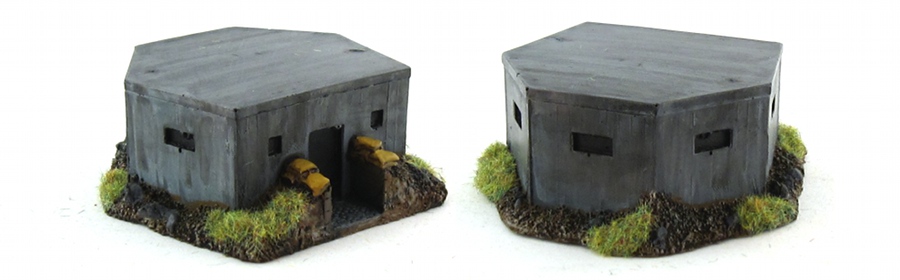
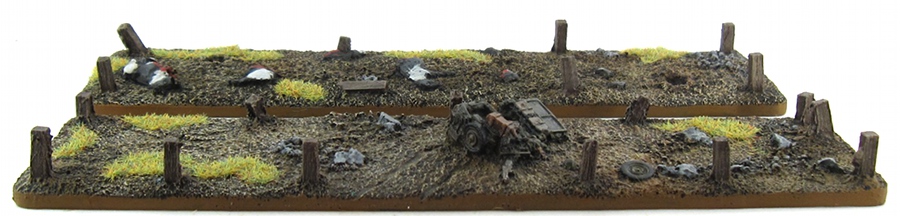
Fortifications: Flames of War has a number of fortifications with formal rules (razor wire, minefields and bunkers). Most of these items are resin figures that I have painted up over the years. The razor wire is just curled up gardening wire.




 Wargaming Workshop